
Review · PARIS
Paris: Millefeuille baking class with a chef
A millefeuille is not just a pretty French cake. It is a useful pastry lesson in disguise, with crisp laminated dough, smooth pastry cream, careful baking, and neat assembly all packed into one dessert. In this Paris workshop, you make the whole thing from scratch with a professional chef rather than simply watching a demonstration.
I like the small group of up to eight, which gives you a better chance to ask questions and get help with tricky dough. I also like that you take home your finished millefeuille, along with a digital recipe, so the class can continue in your own kitchen. The main consideration is the 150-minute schedule: puff pastry takes patience, and the description also refers to the session as three hours, so check the confirmed start and end time before planning another activity.
Key points to know before booking
- You make the pastry from scratch: Learn the basic folding and handling needed for puff pastry, not just the final assembly.
- The chef teaches in English: Instructions and guidance are provided in English throughout the workshop.
- The group is limited to eight: This is a more personal format than a large demonstration class.
- Your dessert is yours to take home: Transport packaging is included, along with tea, coffee, and water during the session.
- The class suits several skill levels: Beginners can learn the basics, while experienced bakers can sharpen their pastry technique.
- The price is $159 per person: That is a serious pastry-class price, but it includes ingredients, instruction, refreshments, packaging, and the finished dessert.
Why millefeuille makes a good Paris pastry class
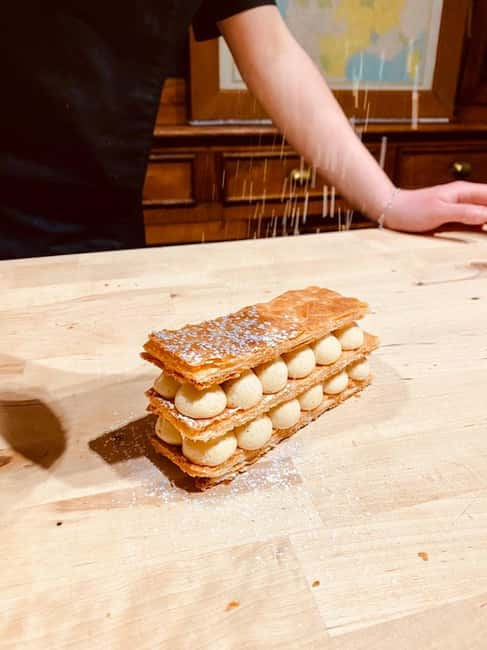
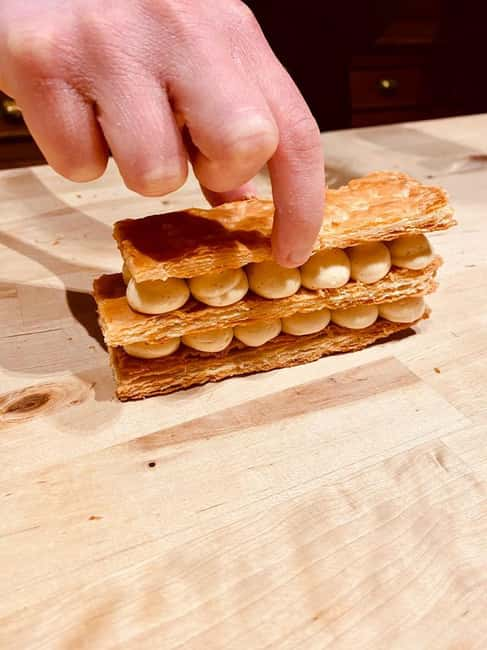
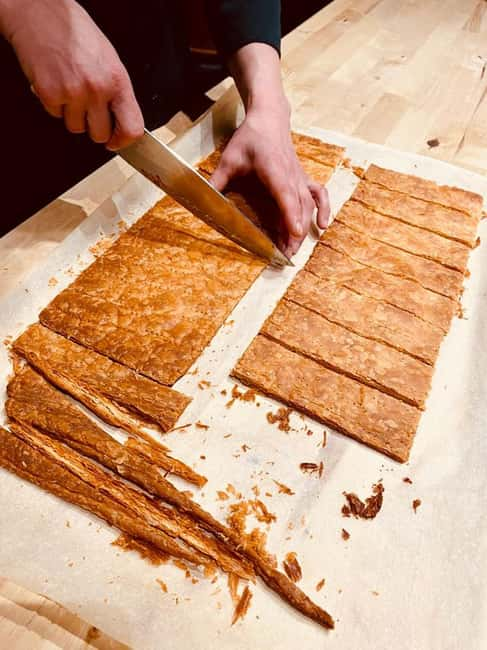
Millefeuille, also called Napoleon, is one of the best desserts for learning how French pastry works. Its name means a thousand leaves, a reference to the many thin layers in the puff pastry. Those layers need to bake crisp and even, while the pastry cream must be smooth enough to spread but firm enough to hold the cake together.
The dessert is often associated with French pastry chef François Pierre de la Varenne, an important figure in the development of French cooking in the 18th century. You do not need to know that history to enjoy the class, but it helps explain why this dessert has such a central place in French baking.
I like this choice for a workshop because the result feels special without requiring a huge menu of separate recipes. You focus on a few core skills, then see how they work together. If you have ever bought a millefeuille in a Paris pastry shop and wondered how the layers stay crisp beside the cream, this class gives you a practical answer.
More Baking and Bread Classes in France
- Paris Croissant Small-Group Baking Class with a Chef
★ 5.0 · 910 reviews - Paris: French Croissant Baking Class with a Chef
★ 4.9 · 712 reviews - Paris Macarons Small-Group Baking Class with a Chef
★ 5.0 · 316 reviews
Starting with puff pastry and butter layers
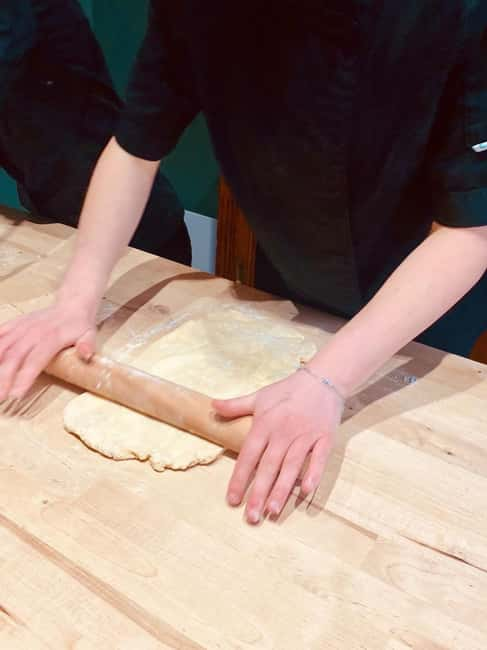
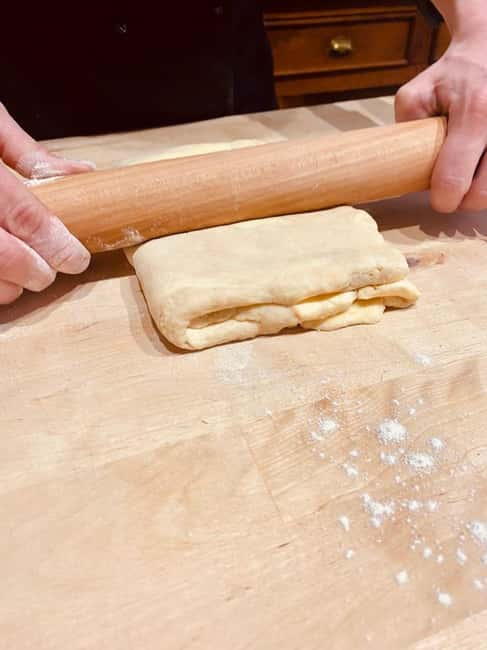
The technical heart of the class is the puff pastry. You work through the process of folding the dough so it develops thin layers that rise in the oven. The exact pace and method come from the chef, who guides you through the important points rather than leaving you to guess.
This is where a professional class can save you frustration. Puff pastry is sensitive to handling and texture. If the dough is worked poorly, it can become difficult to roll or lose its clean layers. You will learn how to approach the dough step by step, with the chef showing you what to look for as you fold and shape it.
The class is not presented as a passive cooking show. You work alongside the chef, which means you should expect to handle the ingredients and take part in the process. That matters for beginners. Watching someone roll pastry is easy. Rolling it yourself, while keeping the layers even, is where the useful learning happens.
Experienced bakers can also get value here. Millefeuille rewards precision, and a chef can point out small habits that improve the final texture. One participant had a one-to-one session and made three millefeuilles, so the exact experience can vary with the group size and booking conditions. Do not assume private instruction is guaranteed, but the small format leaves room for close guidance.
Making silky pastry cream
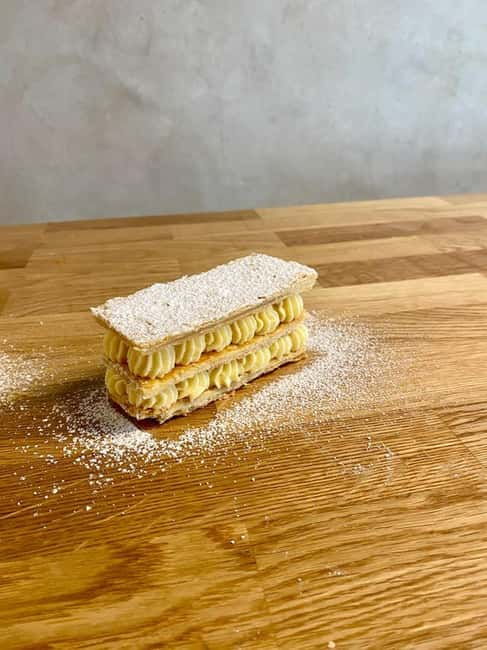
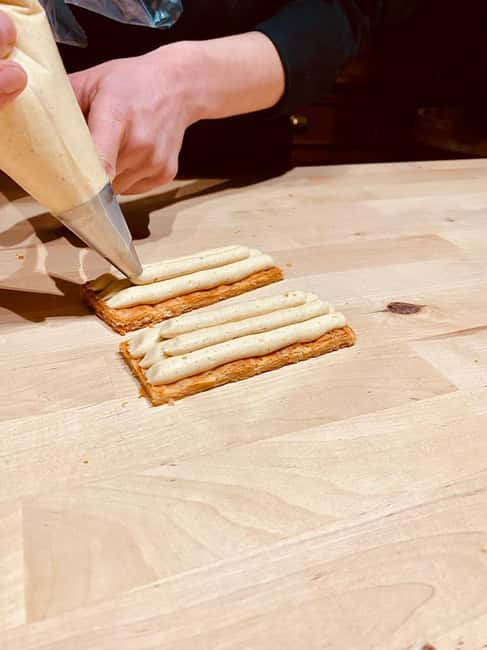
The second major lesson is pastry cream, the soft filling between the pastry layers. You learn how to create the smooth, rich cream that gives millefeuille its contrast. The pastry should be crisp, while the cream should be lush and tender. Getting that balance right is what keeps the dessert from feeling heavy.
This part is especially useful for home bakers because pastry cream has many uses beyond millefeuille. You can use the technique for tarts, choux pastry, layered cakes, and other French desserts. The class gives you one finished dessert, but the method can become part of your wider baking skills.
The chef guides you through texture as well as ingredients. A recipe tells you what to add, but a teacher can help you understand when the cream is ready and how it should feel. That kind of practical correction is one of the strongest reasons to take an in-person class instead of relying only on a cookbook.
The ingredients are supplied, so you do not need to arrive with a shopping bag full of butter, flour, eggs, or sugar. You can focus on the work itself. Tea, coffee, and water are available during the session, though extra food and drinks outside the workshop are not included.
Shaping, decorating, and assembling your dessert
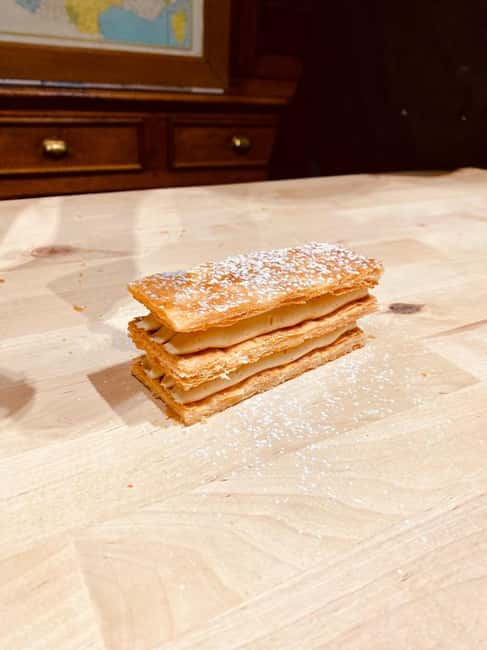
Once the pastry and cream are ready, you move toward the final construction. The layers are assembled with the cream, and you have a chance to add decorative touches. This gives you some creative control without losing the classic character of the dessert.
That personal touch is useful for two reasons. First, it makes the finished millefeuille feel like your own work. Second, it helps you see how presentation affects pastry. Millefeuille is a structured dessert, so clean layers and careful finishing matter as much as flavor.
Do not expect the result to look exactly like a professional pastry-shop display on your first try. The point is to learn the process and leave with something you made yourself. The chef can help you work toward a tidy finish, but handmade pastry has character. A slightly uneven edge is part of the story, not a disaster.
You will enjoy the dessert after the session, and the rest goes into transport packaging for the journey home. That packaging is a practical inclusion. Millefeuille is delicate, and carrying it loose through Paris would be a poor plan. Even so, handle the box carefully and avoid putting heavy items on top of it.
More Baking and Bread Classes in Paris:
- Paris: Macaron Baking Class for Families and Kids
★ 4.7 · 270 reviews - Paris: Macaron Baking Class in Central Paris
★ 5.0 · 208 reviews - Paris: Croissant Baking Class with a Chef
★ 5.0 · 201 reviews - Paris: French Macarons Baking Class with a Parisian Chef
★ 4.7 · 65 reviews
What the small group changes
The group limit is eight people. That is small enough to make questions easier and large enough to create a social cooking experience. You are not stuck at the back of a room trying to see a chef’s hands from across a crowd.
A small class also allows the chef to notice problems as they happen. If your pastry needs more careful handling or your cream is not at the right consistency, you can ask for help before the mistake reaches the final stage. The English instruction makes that exchange simpler for English-speaking participants.
The tone appears friendly and patient. One participant described the chef as warm and engaging, while another praised the chef’s patience and practical tips. Those qualities matter in pastry, where a rushed explanation can leave a beginner confused. A calm teacher can make the difference between feeling lost and understanding why a step matters.
Still, group size can change from one date to another. The maximum is eight, and one booking was handled as a one-to-one class. If personal instruction is important to you, ask about the expected group size when you book rather than treating the private session as standard.
How long the 150-minute class feels
The stated duration is 150 minutes, or two and a half hours. That is enough time for a focused workshop, but it is not an all-day pastry course. You will cover the main techniques and produce a finished dessert, rather than exploring many unrelated French pastries.
The activity description also refers to a three-hour class. Because those times do not match exactly, check the confirmed schedule before booking another timed activity afterward. Allow extra time for arriving, settling in, finishing the dessert, and carrying your boxed pastry away.
The class works well as a planned part of a Paris day. It gives you a clear block of hands-on activity, with no transport between multiple sites. You arrange your own way to the workshop, and the experience is described as easily accessible in Paris. Transportation is not included, so leave enough time to reach the location without rushing.
I would not pair it with a tightly timed museum reservation or train departure. Pastry work has several stages, and the final packaging may take longer than you expect. Give yourself breathing room, especially if you want to enjoy the finished dessert before moving on.
Is $159 a fair price?
At $159 per person, this is not a budget snack or a quick market tasting. You are paying for a guided cooking lesson, ingredients, a finished millefeuille, refreshments, transport packaging, and a digital recipe. The small group and hands-on format are the main factors that support the cost.
The value is strongest if you care about learning technique. If you only want to eat a millefeuille, a Paris pastry shop will cost far less. If you want to understand how the dessert is built and try the process yourself, the class offers more than a purchase from a display case.
The finished dessert also adds a useful take-home element. You are not leaving with only a memory and a few notes. You get a pastry to enjoy later, provided you carry it carefully, plus the recipe needed to repeat the work.
The price may be harder to justify for someone who already makes puff pastry regularly and wants only a quick demonstration. It is better suited to people who value instruction, interaction, and the chance to ask questions. The strong five-star rating across five submitted ratings suggests a good early response, but the sample is small, so I would still choose based on your own interest in pastry rather than on the score alone.
Who will enjoy this workshop most?
This class is a good fit for:
- First-time French pastry students: You get direct guidance through dough, cream, decoration, and assembly.
- Home bakers: The techniques apply to more than one dessert, especially the pastry cream and puff pastry work.
- Families: The experience is designed for different skill levels, and one family booking found the chef patient and pleasant.
- Dessert-focused visitors: You leave with a classic French sweet instead of only a photograph.
- People who prefer small groups: Eight participants is the maximum, and some sessions may be smaller.
- Visitors with accessibility needs: The activity is listed as wheelchair accessible.
It may be less suitable if you want a broad food tour, a full meal, or a lesson covering several pastries. This is a focused workshop built around one demanding dessert.
Practical details that affect your day
The class is taught in English. All baking ingredients are included, as are tea, coffee, and water during the workshop. Additional food and drinks are not included, so plan your appetite accordingly.
You need to arrange your own transportation to the workshop. No transfers between locations are part of the experience. Since the activity takes place in Paris and is described as easy to reach, the main task is simply to allow enough time to get there.
Cancellation is free up to 24 hours before the activity for a full refund. You can also reserve now and pay later, which helps if you are still arranging the rest of your Paris schedule. Check the available starting times before committing, since the class has a fixed duration and may not fit neatly into every day.
A digital recipe is provided after the workshop, with a printed version planned for the future. If you like working from paper, you may need to use your phone or tablet for now.
Should you book the millefeuille class?
Book it if you want a hands-on Paris food experience with a clear result at the end. The best reasons are the small group, English-speaking pastry chef, practical work with puff pastry and cream, and the chance to take your creation home. The chef’s patient, personal teaching style is another plus, especially for beginners.
Skip it if your priority is low cost, a full meal, or a quick taste of French pastry without the work. At $159, the value comes from learning and participation, not from the amount of food alone.
For most pastry fans, this is a smart choice when you have a free two-and-a-half-hour block and want to bring home more than a box from a shop. Confirm the timing, plan your route, and carry the finished millefeuille gently. That is a small price to pay for a dessert you helped build from the first fold to the final decoration.
FAQ
How long does the millefeuille class last?
The stated duration is 150 minutes, or two and a half hours. The activity description also refers to a three-hour class, so check the confirmed timing when selecting a session.
What is included in the price?
The price includes all baking ingredients, instruction from a professional pastry chef, tea, coffee, water, transport packaging for your dessert, and a digital workshop recipe.
Is the class taught in English?
Yes. The instructor language is English.
How many people can join the class?
The class is limited to eight participants. The actual group may be smaller, and one session was handled as a one-to-one class.
Do I take the millefeuille home?
Yes. Your finished creation is packaged for transport so you can take it with you after the workshop.
Is transportation to the workshop included?
No. You arrange your own transportation to the workshop, and no transport between locations is provided.
Can I cancel the booking?
Yes. You can cancel up to 24 hours in advance for a full refund. Reserve now and pay later is also available.
New cooking classes around Paris
- Paris: The Soufflé Baking Class with Chef★ 4.5 · 2 reviews
- Paris: Traditional Croissant Cooking Class With Local Baker★ 5.0 · 2 reviews
- Paris: Macaron Baking Class★ 4.4 · 26 reviews
- Paris: Macarons Cooking Class with Pâtisserie Chef Noémie★ 4.8 · 179 reviews
- Paris: Evening Cooking Class with Optional Market Visit★ 4.8 · 19 reviews
- Paris: Hands-On Small Group Cooking Class★ 4.9 · 19 reviews
- Paris: Lemon Tart Baking Class with a Pastry Chef★ 5.0 · 4 reviews
- Eclair Baking Class with A Pastry Chef★ 5.0 · 3 reviews
Paris Cooking Classes, side by side.
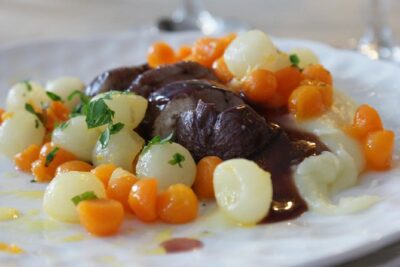
Paris Cooking Class and Lunch with Wine plus Market Visit Option
Read our review →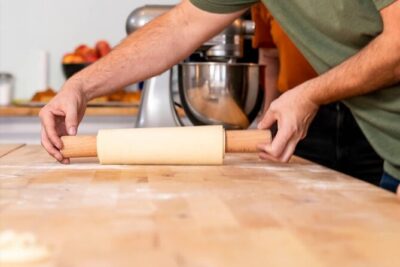
Paris Croissant Small-Group Baking Class with a Chef
Read our review →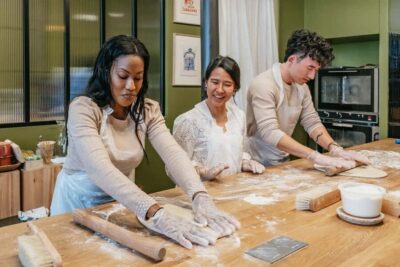
Paris: French Croissant Baking Class with a Chef
Read our review →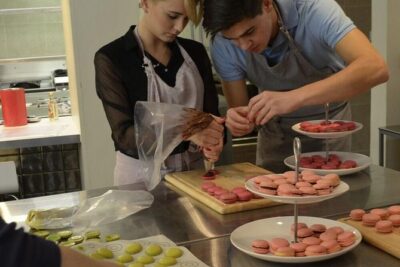
Paris Cooking Class: Learn How to Make Macarons
Read our review →
Paris Evening Cooking Class French Dinner and Market Visit Option
Read our review →
Paris French Cuisine Small Group Cooking Class with Lunch
Read our review →
Paris: Macaron Baking Class for Families and Kids
Read our review →This kitchen also appears in