
Review · PARIS
Paris: Croissant Baking Class with a Chef
A croissant class in Paris is more than a pleasant way to spend a morning. It shows you the hard work behind that simple golden crescent on your breakfast plate. At Studio Pâtisserie, you mix, knead, fold, roll, shape, and bake your own pastries under the close eye of a professional chef.
I like the small group of eight, which gives you real time at the workbench instead of watching from the back. I also like the balance of practical work and pastry science, including butter quality, resting, and proofing. The main consideration is physical effort: rolling laminated dough takes strength, and the class is not suited to children under 15.
Key points to know before booking
- You make the pastry yourself: The class is hands-on from dough preparation through shaping and baking.
- Chef Léo or Chef Maria may lead the session: Both bring clear instruction, humor, and personal help to the workbench.
- Plan on several pastries per person: Sessions commonly produce four butter croissants and four pain au chocolat.
- The dough needs resting time: Some stages pause while the dough rests and rises, so the three-hour format has a natural rhythm.
- It is held near Rome and Villiers: Studio Pâtisserie has a gray storefront and is reached by Metro Lines 2 and 3.
- A bi-colour option is available on selected days: Choose it if you want to add color and extra visual flair to your pastry dough.
What the three-hour Paris pastry class is really like
The class begins at Studio Pâtisserie, a bakery kitchen with a gray-colored storefront in the 17th arrondissement area. The nearest metro stops are Rome on Line 2 and Villiers on Line 3, so you can reach it without turning the morning into a complicated transit project.
Once inside, you gather around the workstations and meet the chef. The teaching is in English. Chef Léo is known for an energetic, funny approach, while Chef Maria brings the same mix of warmth, patience, and careful instruction in her sessions. The exact instructor depends on the class date, so check the booking details if one particular chef matters to you.
The class is limited to eight participants. That number matters. Croissant dough is not difficult because the recipe is secret. It is difficult because small mistakes in pressure, temperature, folding, or timing affect the finished pastry. A small class lets the chef watch your hands and correct you before a minor problem becomes a lopsided croissant.
You should expect to work, not simply watch a demonstration. The chef explains each stage, then gives you a chance to carry it out. That makes this a good choice for a first-time baker, but it also gives experienced home bakers useful details about the process.
More Baking and Bread Classes in France
- Paris Croissant Small-Group Baking Class with a Chef
★ 5.0 · 910 reviews - Paris: French Croissant Baking Class with a Chef
★ 4.9 · 712 reviews - Paris Macarons Small-Group Baking Class with a Chef
★ 5.0 · 316 reviews
Mixing dough, butter, and the first hard work
The first stage covers the dough. You learn how the ingredients come together and why the dough needs the right texture before rolling begins. This is where the class starts to feel different from a casual cooking demonstration. You are not just handed a prepared sheet of pastry. You take part in the work that makes the layers possible.
Rolling and kneading require arm strength. This is the one physical warning worth taking seriously. Several details from the class format point to the same advice: arrive ready to use your hands and shoulders for a while. If you have limited strength or an injury, ask before booking.
The chef also explains why butter matters. Croissant dough is a partnership between flour and butter, and the butter must remain workable without disappearing into the dough. You learn that the quality and condition of the butter affect both texture and flavor.
I appreciate this kind of explanation because it gives you a reason for every step. At home, it is much easier to follow a recipe when you understand what the dough should feel like, rather than simply waiting for a timer.
Folding and laminating the layers
The signature croissant texture comes from repeated folding and rolling. This creates thin layers of dough and butter, which later separate in the oven. The technique looks simple when a trained pastry chef does it. In your hands, it takes attention.
The chef demonstrates how to roll the dough evenly and how to fold it with care. You learn to avoid pressing too hard, tearing the dough, or allowing the butter to break through. The instruction is practical and direct. You can ask questions as you work, and the chef moves around the group to check each person’s progress.
This is one of the strongest reasons to choose a small class. A large group might leave you guessing if your dough is too warm, too thick, or uneven. Here, the chef can give you a quick correction and explain why it matters.
The class also teaches patience. The dough cannot be rushed from mixing to the oven. It needs time to rest and rise between stages. That pause may make the process feel less continuous, but it is part of the lesson. You see that good croissants depend on timing as much as on ingredients.
The useful science behind a flaky croissant
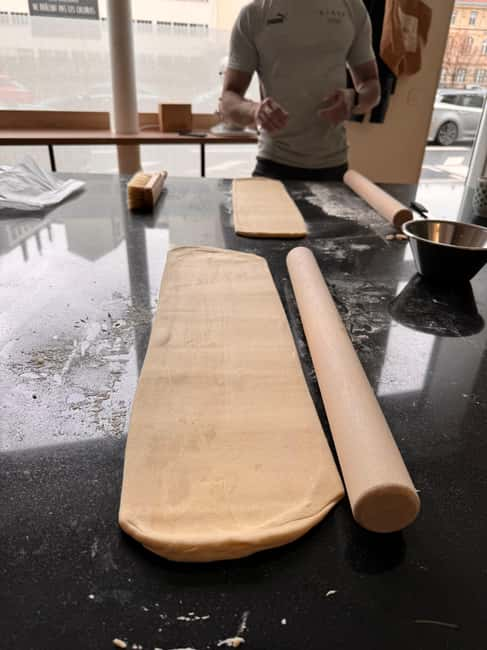
During the resting periods, the chef discusses the science and history of croissant making. The focus stays useful rather than academic. You learn about butter, gluten, proofing, texture, and flavor, all of which help explain why a croissant can be light and crisp or dense and heavy.
Proofing is especially important. The dough needs time to develop before baking, and the finished pastry depends on getting this stage right. The chef explains what to watch for and how the dough changes as it rises.
This theory is valuable if you want to repeat the recipe in your own kitchen. You leave with more than a list of ingredients. You have a better idea of what you are trying to achieve at every stage.
The class includes a recipe to take home, and the instruction includes small tips that are easy to miss in a standard cookbook. Some participants have found it useful to write down extra notes or record parts of the demonstration, if the chef allows it. Pay attention during the resting periods, since this is often when the most helpful explanations happen.
More Baking and Bread Classes in Paris:
- Paris: Macaron Baking Class for Families and Kids
★ 4.7 · 270 reviews - Paris: Macaron Baking Class in Central Paris
★ 5.0 · 208 reviews - Paris: French Macarons Baking Class with a Parisian Chef
★ 4.7 · 65 reviews - Paris: Macaron Baking Class
★ 4.4 · 26 reviews
Shaping croissants and pain au chocolat
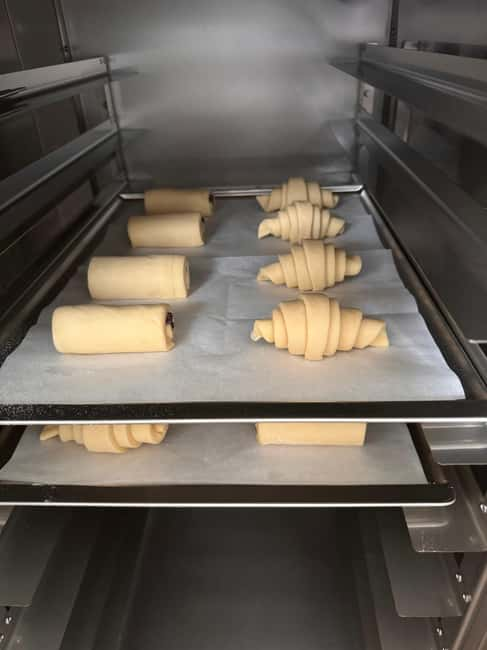
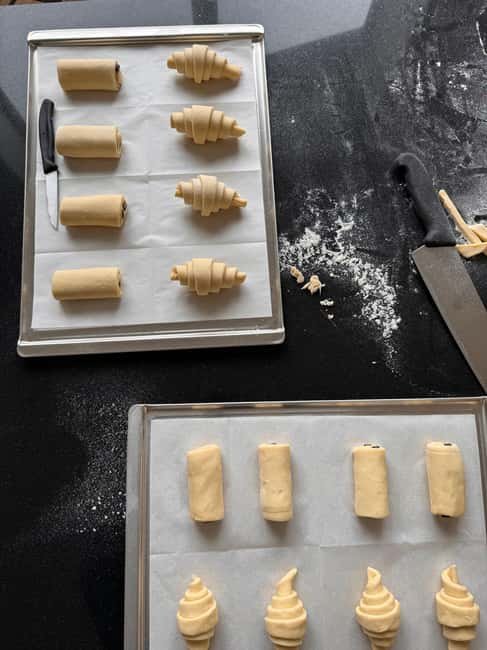
Once the dough is ready, you roll it out and cut it into pieces. The chef shows you how to shape the classic crescent form, including the way to roll the triangle so the layers expand properly in the oven.
The class commonly includes both butter croissants and pain au chocolat. A typical session produces four of each per person, giving you eight pastries to sample and take away. The exact arrangement can depend on the class, but you should plan for a generous quantity.
Shaping is the most satisfying part for many people because the dough begins to look like a real pastry. It is also where small differences between participants become obvious. Some crescents may be tighter, larger, or more curved than others. That is part of the fun, and the chef helps you improve the form without making the activity feel like a test.
The pain au chocolat adds a welcome change from the crescent shape. You work with chocolate inside the dough, then prepare it for baking alongside the butter croissants. If you are visiting with someone who prefers chocolate pastries, this makes the class appealing to a wider range of tastes.
Baking and eating what you made
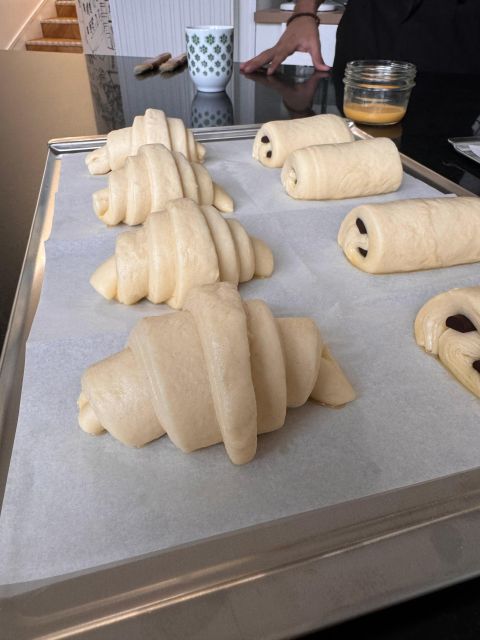
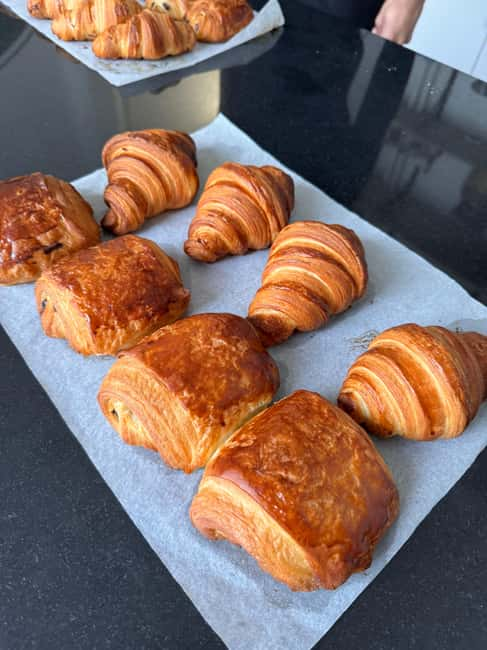
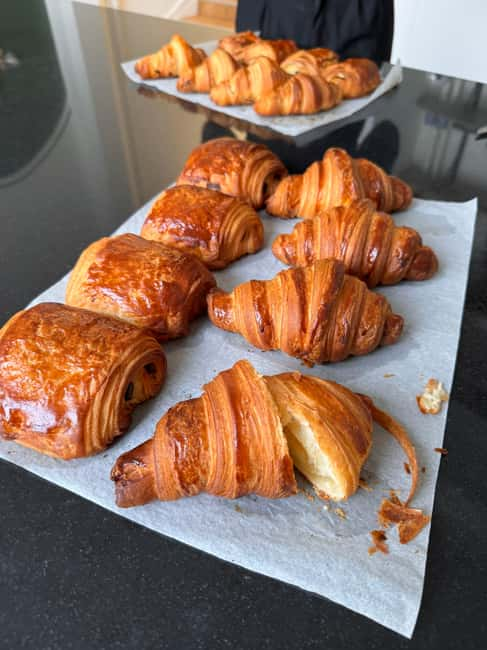
The final stage brings the class together. Your shaped pastries go into the oven, and the kitchen fills with the smell of fresh baking. The wait is part of the reward, since you have followed the dough from its first mixture to the finished pastry.
You sample freshly baked croissants during the class. Several sessions also include a beverage at the end, giving you a simple Parisian pause with the results of your work. The pastries you do not eat can be taken away, so bring a bag with enough room for a generous bundle.
The finished pastries are not just souvenirs. They give you a direct lesson in how dough handling affects the result. You can compare the crisp outside, soft layers, and buttery interior with what you made at the workbench.
Do not assume you need professional baking skills to get a good result. The chef’s close supervision is designed to help beginners. At the same time, experienced bakers can ask more detailed questions about texture, proofing, and technique.
The optional bi-colour croissant class
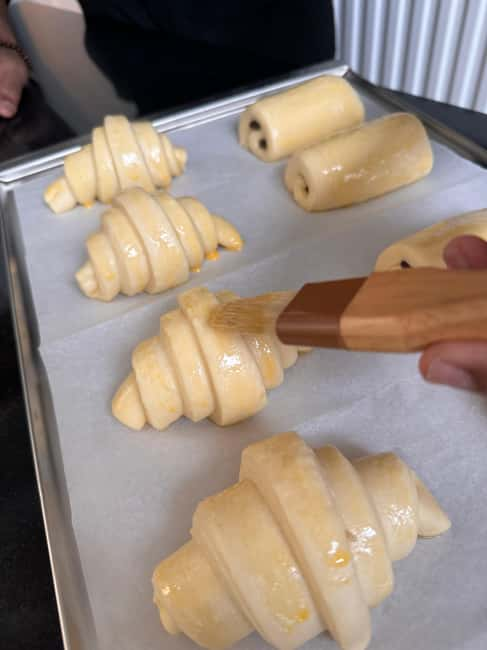
On selected days, you can book a bi-colour croissant option. This teaches you how to add colored dough to the pastry while keeping the layers and shape intact.
The option is aimed at bakers who want a more decorative result, but it is not only for experts. It adds a creative element to the standard class and gives you another way to think about pastry design.
Check the available date and option carefully before booking. The bi-colour class is not presented as a feature of every session. If your main goal is learning the classic butter croissant, the regular format is the straightforward choice. If you want something more unusual to photograph or repeat at home, the colored dough adds interest.
Why the small group changes the experience
With a maximum of eight people, the class feels personal without becoming awkward. You work alongside other participants, but the chef has enough time to visit each station.
That is important during folding and shaping. A pastry chef can spot uneven rolling or a weak seal with one glance. Personal correction is more useful here than a long lecture.
The group also works well for different types of visitors. Couples can make the class part of a food-focused day. Parents and older teenagers can share the work, provided the age rules are followed. Solo participants can join without needing to bring a partner, since the class is structured around individual pastries.
The atmosphere is friendly and informal. Chef Léo, in particular, brings humor and energy to the teaching, while Chef Maria is described as funny, patient, and encouraging. The tone helps take the pressure out of a technical activity.
Is $140 a fair price?
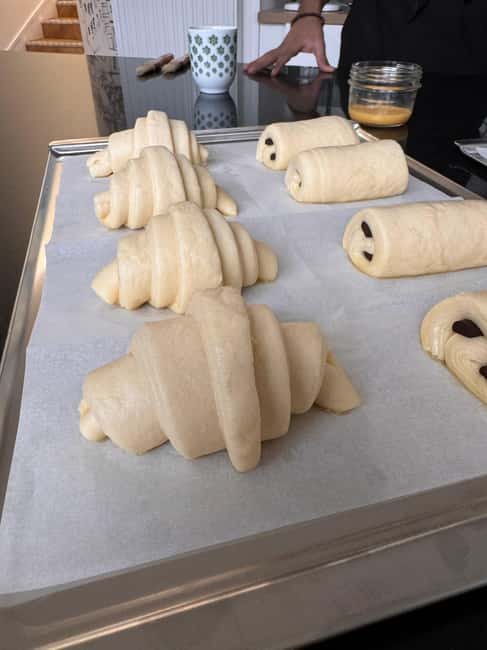
At $140 per person, this is not a budget breakfast. You could buy excellent croissants from a Paris bakery for far less. The value comes from the instruction, the hands-on work, the professional kitchen, the ingredients, the pastries you make, and the recipe you take home.
The class lasts three hours, which gives the fee more weight than a short demonstration. You spend that time learning a skill and producing several pastries rather than simply eating one.
I think the price makes sense for someone who values an activity as much as a meal. It is less compelling if you only want to taste a croissant or if your schedule is packed with other food stops. You are paying for time, guidance, and the chance to repeat the experience at home.
The amount of pastry also improves the value. Making four butter croissants and four pain au chocolat per person can leave you with more than you want to eat at once. That is good news if you have a hotel room or apartment where you can enjoy them later, but it also means you should plan how to carry them.
Who should book this class?
I would recommend it to people who want an activity with a clear connection to Paris. Croissants and pain au chocolat are familiar symbols of French food, but this class shows you the labor behind them.
It suits:
- First-time bakers who want close guidance
- Home bakers looking to improve laminated dough
- Couples and families with older children
- Solo visitors who enjoy hands-on activities
- Food lovers who want more than a tasting
- Visitors with a rainy morning to fill
Children under 15 are not suitable for the class, and anyone under 17 must be accompanied by a paying adult. The dough requires physical effort, so consider that before booking for a child or anyone with limited arm strength.
The class is conducted in English, making it practical for English-speaking visitors. The central Paris location and nearby metro stations also make it easy to fit into a larger day of sightseeing.
Small practical details that matter
Wear clothing you do not mind using in a working kitchen. The class is hands-on, and you will be handling dough, butter, and chocolate through several stages.
Arrive at the gray-fronted Studio Pâtisserie and allow enough time to find the entrance. Rome and Villiers are the nearest metro stops, with Line 2 serving Rome and Line 3 serving Villiers.
You can cancel up to 24 hours before the activity for a full refund, and the reserve-now, pay-later option helps if your Paris schedule is still changing. Starting times vary, so check the available slot before arranging other plans.
If you want the bi-colour version, select that option for a date when it is offered. If the standard class is your priority, the regular croissant and pain au chocolat format gives you the clearest introduction to the craft.
Should you book the Studio Pâtisserie class?
Book it if you want to understand croissants by making them, not just eating them. The strongest features are the maximum eight-person group, close chef guidance, generous pastry output, and the useful mix of technique and science.
Skip it if you dislike repetitive physical work, have little room in your schedule for a three-hour activity, or only want a quick pastry stop. For everyone else, this is a practical and memorable addition to a Paris itinerary. You leave with fresh pastries, a recipe, and a better sense of why a good croissant takes so much care.
FAQ
How long does the croissant baking class last?
The class lasts three hours. Check the available dates for the specific starting time.
Where does the class meet?
It meets at Studio Pâtisserie, a building with a gray-colored storefront. The nearest metro stations are Rome on Metro Line 2 and Villiers on Metro Line 3.
Is the class taught in English?
Yes. The listed class language is English.
How many people are in the group?
The class is limited to eight participants, allowing the chef to offer personal guidance at the workstations.
Are ingredients and equipment included?
Yes. The price includes the ingredients, professional-grade kitchen equipment and tools, and the ingredients for the bi-colour version if you select that option.
Can children take the class?
Children under 15 are not suitable for the activity. Anyone under 17 must be accompanied by a paying adult. Croissant making also requires enough physical strength to roll out the dough.
New cooking classes around Paris
- Paris: The Soufflé Baking Class with Chef★ 4.5 · 2 reviews
- Paris: Traditional Croissant Cooking Class With Local Baker★ 5.0 · 2 reviews
- Paris: Macarons Cooking Class with Pâtisserie Chef Noémie★ 4.8 · 179 reviews
- Paris: Millefeuille baking class with a chef★ 5.0 · 5 reviews
- Paris: Macaron Baking Class★ 4.4 · 26 reviews
- Paris: Evening Cooking Class with Optional Market Visit★ 4.8 · 19 reviews
- Paris: Hands-On Small Group Cooking Class★ 4.9 · 19 reviews
- Paris: Lemon Tart Baking Class with a Pastry Chef★ 5.0 · 4 reviews
Paris Cooking Classes, side by side.
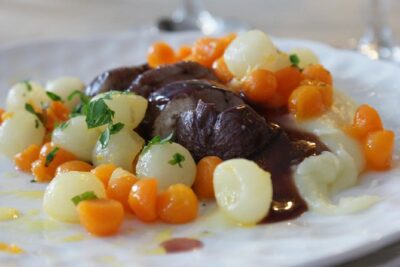
Paris Cooking Class and Lunch with Wine plus Market Visit Option
Read our review →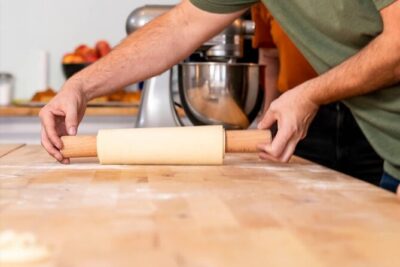
Paris Croissant Small-Group Baking Class with a Chef
Read our review →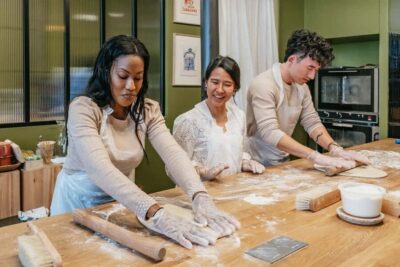
Paris: French Croissant Baking Class with a Chef
Read our review →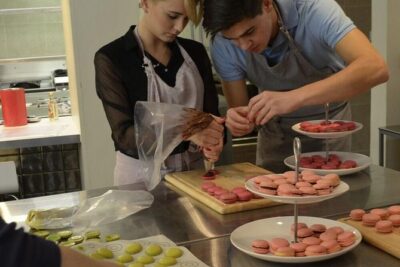
Paris Cooking Class: Learn How to Make Macarons
Read our review →
Paris Evening Cooking Class French Dinner and Market Visit Option
Read our review →
Paris French Cuisine Small Group Cooking Class with Lunch
Read our review →
Paris: Macaron Baking Class for Families and Kids
Read our review →This kitchen also appears in