
Review · OSAKA
Okonomiyaki&Takoyaki for Families:Osaka Street Food Festival
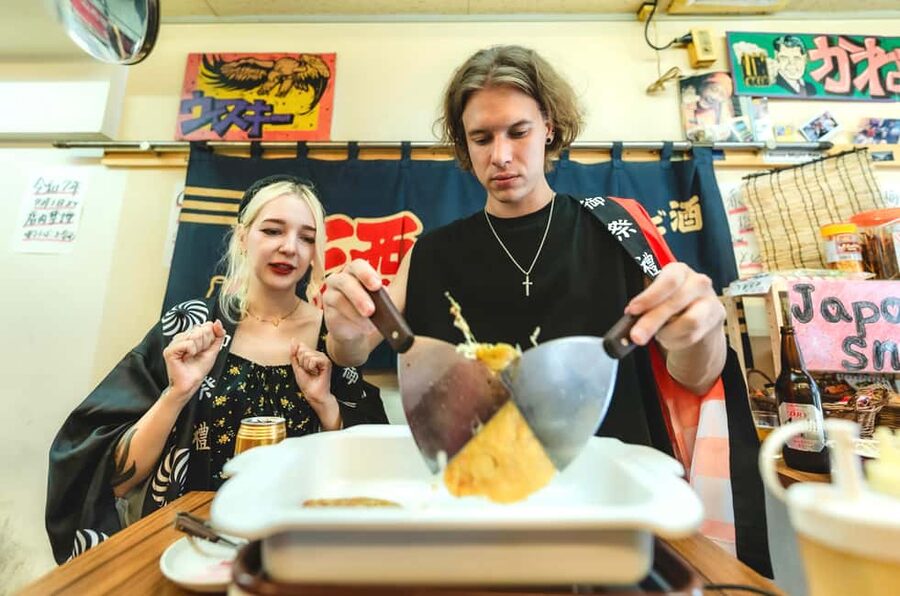
Osaka’s famous street food becomes a group activity here: you cook takoyaki and okonomiyaki at your own table, then eat what you make while dressed in a colorful happi coat. The festival setting adds more than a meal, with dagashi snacks, a classic game, photos with Takoyaki Baby characters, and a certificate at the end.
I like the hands-on cooking and the fact that children, parents, and grandparents can take part together. I also like the friendly English-language help, with J’ayla receiving specific praise for making the session fun. The main consideration is price: at $64 per person, this costs more than simply buying street food, so you should want the cooking, games, costumes, and group setting as part of the meal.
Key points to know before booking
- You cook on real teppan grills: Make takoyaki and okonomiyaki side by side instead of only watching a demonstration.
- Six daily ingredients add variety: The available ingredients change by day, giving the cooking a small element of surprise.
- The 90-minute format stays active: Food, snacks, photos, games, and certificate time are packed into one short session.
- Happi coats make it feel like a festival: Dressing up helps turn a meal into a shared Osaka-themed activity.
- Dagashi snacks are unlimited: You can try classic Japanese sweets and small snacks while cooking.
- The price covers more than food: A drink, game, host, coat rental, and Takoyaki Master certificate are included.
Turning Osaka street food into a family activity
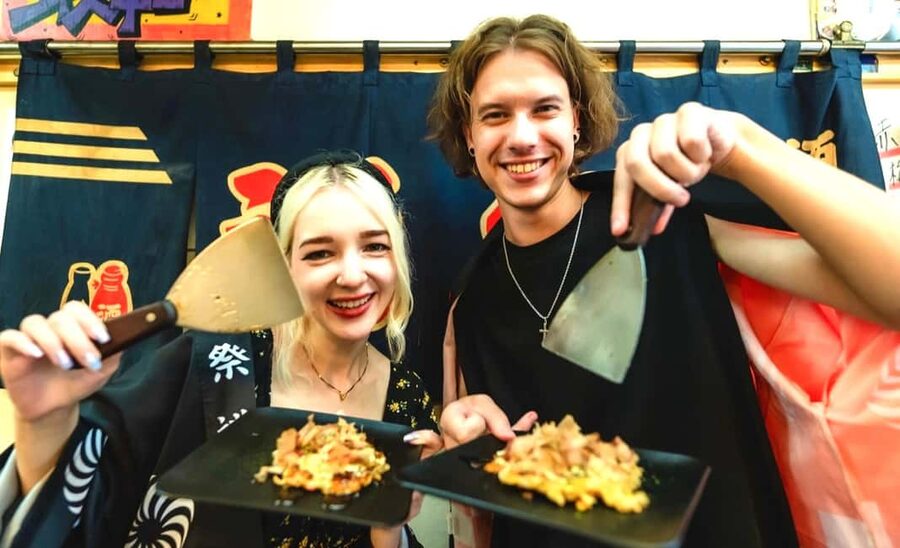
Takoyaki is one of Osaka’s signature foods: small batter balls cooked in a special round mold, usually with fillings and toppings. Okonomiyaki is a savory pancake cooked on a hot plate. Both dishes are linked to casual Osaka dining, where the pleasure comes from eating together as much as from the food itself.
At TAKOYAKI BABY, you do not simply sit down and receive a finished plate. You take part in the cooking with your group, using real teppan grills. That matters if you are looking for an activity that gives children a role, rather than another meal where they need to sit still.
The format also works well for mixed-age groups. An elementary-school child can help with the cooking and games, while adults handle the hotter parts of the grill with guidance from the host. Grandparents can enjoy the food and festival atmosphere without needing to keep up with a long walking tour.
I would not treat this as a formal cooking school. The goal is fun, shared participation, and plenty of food, not a detailed culinary lesson. If you want to master restaurant-level technique, this may feel light. If you want a lively food activity where everyone has something to do, it makes more sense.
More aprons waiting around Osaka:
- Sushi Making Osaka! Popular Sushi Class in Japan!
★ 5.0 · 500 reviews - Osaka: Ramen and Gyoza Cooking Class in Dotonbori
★ 5.0 · 378 reviews - Osaka Cooking Class: Okonomiyaki &Japanese cuisines experience
★ 5.0 · 261 reviews
What happens during the 90-minute session
The experience begins at the meeting point, marked by a Family Mart diagonally ahead to the left. Since the supplied directions are brief, I would check the exact booking details and allow time to identify the location before the start time.
Once inside, the festival theme begins with the colorful happi coats. These traditional-style coats make the setting feel more playful and give your group an easy way to take photos together. They are especially useful for families who want a clear souvenir image without arranging a separate photo stop.
The host then helps you get started with the food. You make takoyaki and okonomiyaki alongside the people in your group, rather than watching someone else do all the work. For first-time takoyaki makers, this is the main event. You get to see how the mixture changes as it cooks and how the small portions become something you can eat.
The available selection includes six unique daily ingredients. Since those ingredients vary by day, the cooking choices are not exactly the same for every booking. I would ask the host what is available when you arrive, especially if someone in your group has a strong food preference.
The food is designed for eating as you go. All-you-can-eat takoyaki is included, while the experience also includes making okonomiyaki. The supplied details do not specify that okonomiyaki is unlimited, so I would think of the unlimited food promise as applying clearly to takoyaki, with okonomiyaki included as part of the cooking session.
Why the cooking is more fun than a normal Osaka meal
The best part of this activity is the small amount of work between you and the food. Takoyaki is not just placed in front of you. You help make it, watch it cook, and share the results with your group.
That makes this a good choice for people who want something social. A family can divide tasks, with one person helping prepare the mixture, another working at the grill, and others choosing snacks or taking photos. The activity gives everyone a part, even if not everyone wants to cook for the full 90 minutes.
The cooking also creates a natural reason to talk with the host. The English-speaking instructor can help guide the process, and the positive feedback about J’ayla suggests that the human side of the session is important. Specific staff assignments may change, so I would not book on the assumption that J’ayla will lead every time.
You should keep your expectations practical. Cooking at a hot grill can be messy, and first attempts may not look perfect. That is part of the point. This is not a polished restaurant meal, and you should not expect every piece to come out identical. The payoff is eating food you helped prepare.
Dagashi snacks and classic festival games
The food is only one layer of the experience. Unlimited Japanese dagashi snacks are included, giving you a chance to try the inexpensive sweets and small treats often associated with childhood snack culture in Japan.
Dagashi are useful here because they give the group something to do while the main cooking continues. Children can sample different snacks, and adults who are curious about Japanese food culture get a taste of everyday treats beyond the usual sushi, ramen, and matcha sweets.
A classic festival game is also included. The listed example is super ball scooping, a simple Japanese festival activity in which you try to scoop small rubber balls without breaking the paper scoop. It is easy to understand, quick to try, and suitable for a mixed-age group, though younger children may need help.
I like this part because it keeps the session from becoming a single long cooking task. If one child loses interest in the grill, the snacks and game provide a change of pace. The tradeoff is that the 90 minutes must cover several activities, so no single part is likely to receive the attention of a full cooking class.
Same kitchen, a different dish:
- Osaka: Roll and Authentic Sushi Making Class in Dotonbori
★ 4.9 · 239 reviews - Osaka Sake Tasting with Takoyaki Cooking
★ 5.0 · 156 reviews - Osaka: Cooking Class Ramen & Gyoza Course in Nanba
★ 4.9 · 86 reviews - Osaka: Gluten-Free Ramen and Gyoza Cooking Class
★ 5.0 · 42 reviews
Photos with Takoyaki Baby characters
The Takoyaki Baby characters give the activity a clear photo moment. You can take group pictures in the happi coats and pose with the characters, which may appeal to families and younger children looking for a cheerful Osaka souvenir.
This is not a sightseeing stop with a city view or historic building. It is an indoor-style food and festival setting built around playful presentation. That makes it a good backup for a rainy day or for an afternoon when your group wants a break from walking, though the supplied details do not specifically promise a weather-related arrangement.
For social media, the costumes and character backdrop do more work than an ordinary restaurant table. You can get photos of the group taking part, not only photos of the finished food. If you prefer quiet meals and dislike posing, this part may feel unnecessary.
The Takoyaki Master certificate
At the end, each participant receives a Takoyaki Master certificate. It is a simple souvenir, but it gives the activity a clear finish and works well for children who like collecting proof of what they have done.
The certificate should not be confused with a professional cooking qualification. Its value is personal and playful. You made the food, played the festival game, and now have something physical to take home.
I find this kind of small souvenir more useful than another generic food photo because it helps children remember the activity later. For adults, it may be a humorous keepsake rather than a serious memento. That is fine, as long as you book with the right expectations.
Is the $64 price good value?
The adult price is $64 per person. That is a sizeable spend for a 90-minute food activity, especially in Osaka, where you can find inexpensive takoyaki and okonomiyaki elsewhere.
The comparison is not quite fair, though. Here, your payment includes a local host guide, all-you-can-eat takoyaki, unlimited dagashi snacks, one free drink, the happi coat, a festival game, and the certificate. You are paying for a hosted activity and a meal, not just a serving of street food.
I think the value works best for families and groups. If four people are cooking, playing, taking pictures, and eating together, the experience can replace a meal plus another short activity. It is less compelling for someone who only wants to taste Osaka food cheaply.
Additional drinks cost extra, although an all-you-can-drink upgrade is available for an additional fee. If your group expects several drinks, check that upgrade before booking and compare the total cost. One drink is included, so moderate drinkers may not need the add-on.
Children in elementary school and under cost ¥7,000. Children under three are not suitable for the activity. Since the session involves hot grills and active participation, families should consider the child’s age and attention span before reserving.
Who will enjoy this most?
I would choose this experience for families who want a low-stress group activity in which children can participate directly. It also suits friends, couples, large groups, and solo visitors who like meeting a host and trying food through an organized activity.
The format is particularly useful when members of your group have different interests. One person may care about Osaka food, another about photos, and another about games. The session gives each person a reason to join in.
Solo visitors can also book, as the activity is not limited to private family groups. Still, the social value may feel stronger when you already have companions. If you are traveling alone and prefer a quiet meal, a regular restaurant may suit you better.
The English instruction is a helpful feature for international visitors. You do not need to depend on guessing your way through the cooking. The experience is also wheelchair accessible, which makes it a practical option for many visitors who need an accessible activity.
Practical details that affect your choice
The session lasts 90 minutes. That is long enough to cook, eat, play a game, take photos, and receive the certificate, but short enough to fit into a busy Osaka day.
You should book ahead because spots can fill quickly. The activity has a fixed starting time, so check availability and avoid scheduling it too close to a train departure or another timed booking.
Free cancellation is available up to 24 hours in advance for a full refund. You can also reserve now and pay later, which helps if your Japan schedule is still changing. These terms make the booking less risky, but you should still confirm the exact conditions shown for your selected date.
The meeting point information is limited to the Family Mart landmark. I would save the address, meeting instructions, and booking confirmation before leaving your hotel. A clear screenshot can be useful if you are navigating in a busy part of Osaka.
How this compares with eating street food on your own
Buying takoyaki from a street stall is cheaper and more spontaneous. You can choose your own shop, eat quickly, and move on to the next sight. That is the better plan if your priority is simple local food at the lowest cost.
This activity offers something different. You get a host, cooking equipment, a festival setting, group photos, snacks, a game, and a certificate. It turns Osaka food into a planned event, which can be valuable when you want a shared memory rather than another meal between sightseeing stops.
I would not schedule it for someone who has already booked several cooking classes. The teaching element here is paired with entertainment, so the cooking may feel less detailed than a dedicated culinary lesson. I would also avoid it for children under three, as they are specifically not suitable for the experience.
Should you book the Osaka street food festival?
Book it if you want to cook Osaka food with your group, enjoy a playful festival setting, and value activities beyond the meal itself. The strongest reasons are the real teppan cooking, unlimited takoyaki, dagashi snacks, happi coats, and the mix of food with games and photos.
Skip it if you only want the cheapest takoyaki in town or a quiet sit-down dinner. At $64, the activity earns its price through participation and extras, not through the food alone.
For most families, friends, and larger groups, I think it is a good fit. The 90-minute length is manageable, the English-speaking host keeps the cooking approachable, and the certificate gives children a fun finish. Check the meeting details, confirm the ingredients available on your date, and decide if the drink upgrade is worthwhile before you reserve.
FAQ
How long does the Osaka street food festival last?
The experience lasts 90 minutes.
What food can I make?
You can make takoyaki and okonomiyaki using real teppan grills. Six unique ingredients are available daily, with the selection changing by day.
Is the takoyaki unlimited?
Yes. All-you-can-eat takoyaki is included.
Are drinks included?
One free drink is included. Additional drinks cost extra, and an all-you-can-drink upgrade is available for an additional fee.
Are snacks included?
Yes. Unlimited Japanese dagashi snacks are included.
What activities are included besides cooking?
You can wear a festival-style happi coat, play a classic Japanese festival game, take photos with Takoyaki Baby characters, and receive a Takoyaki Master certificate.
Is the experience taught in English?
Yes. The instructor language is English.
Can children join?
Children can join, including elementary-school children and younger children, but children under three are not suitable. The listed price for children in elementary school and under is ¥7,000.
Is the activity wheelchair accessible?
Yes. The experience is wheelchair accessible.
New cooking classes around Osaka
- Osaka Sake Tasting with Takoyaki Cooking★ 5.0 · 156 reviews
- Osaka: Sashiko Japanese Craftsmanship Workshop★ 5.0 · 31 reviews
- Osaka: Japanese Cooking Class with Matcha Experience★ 5.0 · 4 reviews
- Osaka Okonomiyaki Cooking Experience for Families & Groups★ 4.9 · 8 reviews
- Osaka: Okonomiyaki Cooking Class with Beer or Soft Drink★ 4.9 · 9 reviews
- Osaka: Gluten-Free Ramen and Gyoza Cooking Class★ 5.0 · 42 reviews
- Osaka : Exclusive Tea Ceremony & Wagashi Cooking★ 5.0 · 2 reviews
- Osaka: Cooking Class Ramen & Gyoza Course in Nanba★ 4.9 · 86 reviews
Osaka Cooking Classes, side by side.

Sushi Making Osaka! Popular Sushi Class in Japan!
Read our review →
Osaka: Ramen and Gyoza Cooking Class in Dotonbori
Read our review →
Osaka Cooking Class: Okonomiyaki &Japanese cuisines experience
Read our review →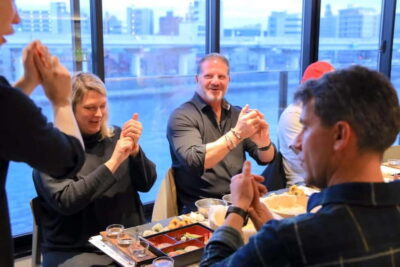
Osaka: Roll and Authentic Sushi Making Class in Dotonbori
Read our review →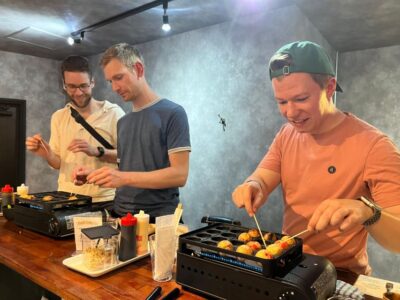
Osaka: Cooking Class Ramen & Gyoza Course in Nanba
Read our review →
Osaka: Gluten-Free Ramen and Gyoza Cooking Class
Read our review →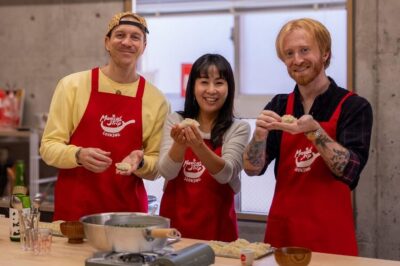
Osaka: Cooking Class & Sake Tasting with Local Market Visit
Read our review →This kitchen also appears in