
Review · JAPAN
Nara: Udon and Tempura Cooking Class with Tasting
Making udon by hand is the main event here, and it is more physical than most cooking classes. You mix domestic wheat with water, knead the dough, and even step on it to build a firm, springy texture before rolling and cutting the noodles yourself. I like the full start-to-finish process and the chance to eat exactly what you made.
I also like the small group of up to 10 people, with careful guidance from professional udon craftsmen. The tempura adds a second useful skill, not just another dish to taste. The main drawback is simple: this is not suitable for anyone with a wheat allergy or gluten intolerance, and the two-hour schedule leaves little room to linger over extra dishes.
Key points at a glance
- Step on the dough: Use your feet as part of the traditional kneading process to make the udon elastic.
- Cut your own noodles: Roll the dough evenly, then use a knife to create the final strands.
- Fry seasonal tempura: Learn batter mixing and oil-temperature control before cooking vegetables and shrimp.
- Choose your bowl: Order udon hot or cold, then add toppings such as green onions, grated daikon, and a hot spring egg.
- Taste fragrant dashi: The broth uses kelp and bonito for a clean, savory base.
- Book for language support: Instruction is available in English, Chinese, and Japanese.
What makes this Nara cooking class worth your time
Nara has no shortage of temples, deer, and historic streets. A hands-on food class gives you a different way to spend part of the day. Instead of only looking at Japanese culture, you work with two everyday staples: udon and tempura.
The class takes place at a popular udon restaurant in Nara City. That matters because you are learning in a working food setting rather than a generic classroom. The focus stays on practical cooking, with the chef explaining each stage and helping you handle the dough, knife, batter, and hot oil.
At $52 per person, the price is fair for a two-hour activity that includes instruction, ingredients, the meal you prepare, an apron, and cooking tools. You are paying for more than lunch, but the value depends on how much you enjoy doing the work. If you want a quick meal with no effort, order udon at a restaurant. If you want to understand how the noodles get their texture, this class earns its price.
The class has received two five-star verified ratings, with particular praise for clear explanations and the complete noodle-making process. That matches the design of the activity: it is not a short demonstration followed by a tasting. You take part from flour and water through to the final bowl.
More cooking classes around Japan:
- Ramen Cooking Class at Ramen Factory in Kyoto
★ 5.0 · 1,937 reviews - Ramen & Gyoza Cooking Class in Tokyo with Local Supermarket Visit
★ 5.0 · 823 reviews - Kyoto: Ramen Cooking Class at a Ramen Factory with Souvenir
★ 4.9 · 532 reviews
Starting with flour, water, and a traditional knead
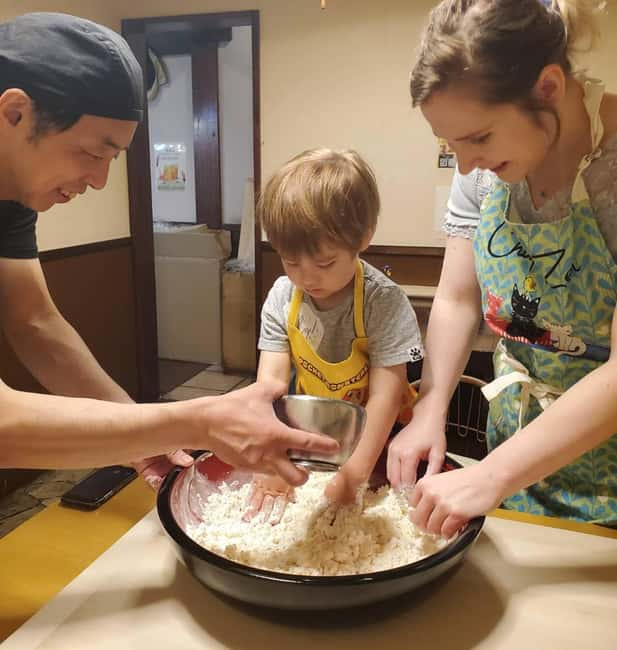
The chef begins with an explanation and demonstration. You measure domestic wheat, add water, and mix the ingredients. At this stage, the dough may look plain, but the handling determines the texture of the finished noodles.
Next comes kneading. You work the dough until it begins to firm up, then step on it to make it more elastic. This is likely to be the most memorable part for children and first-time cooks. It is also a useful reminder that good udon is built through controlled effort, not just a clever recipe.
The stepping is done as part of the instruction, with safety and hygiene managed by the class. Aprons and tools are supplied, so you can arrive empty-handed apart from wearing comfortable clothes. Since the class runs in all weather, it can fill a rainy afternoon just as well as a clear one.
Do not expect a quiet, delicate pastry-style lesson. Kneading and stepping take some work, and the dough must be handled with care. The reward comes later, when you can feel the difference between handmade noodles and a packet of ordinary noodles.
Rolling and cutting noodles by hand
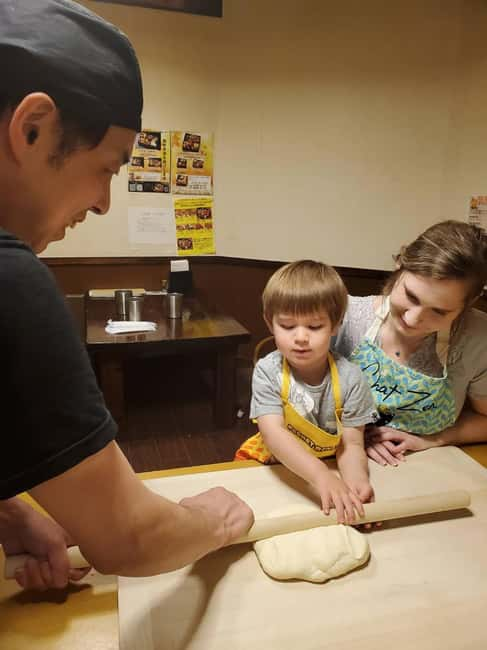
Once the dough is firm and elastic, you stretch it evenly on a rolling board. This is where professional support helps. Getting an even thickness can be tricky for beginners, and the craftsmen provide careful assistance rather than leaving you to guess.
You then cut the dough with a knife. The width of the strands affects how the udon feels in your mouth and how it cooks. Your noodles may not all be identical, and that is part of the appeal. You are learning a craft, not operating a factory machine.
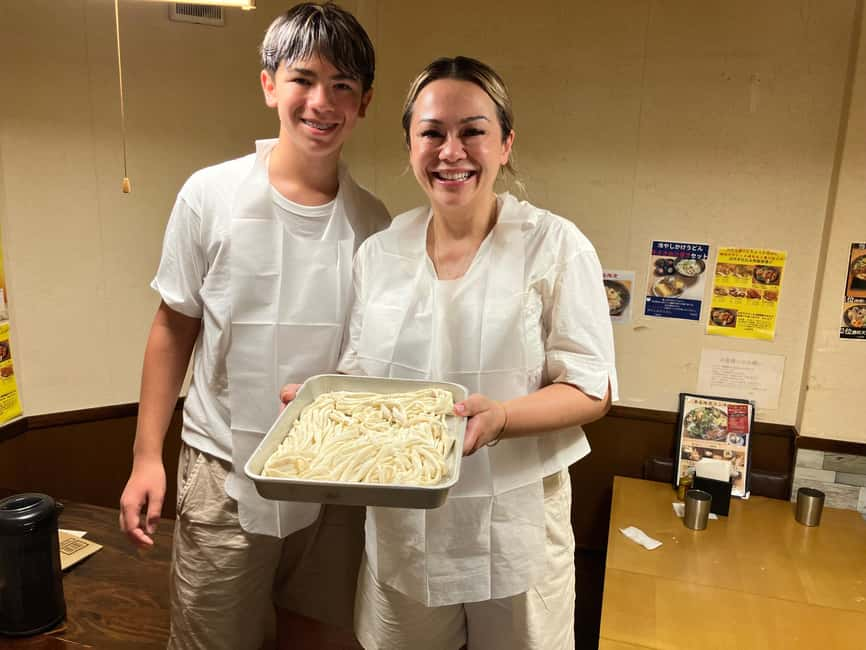
This stage gives the class its strongest educational value. You see how a few basic ingredients become a meal through technique. The process also makes a useful souvenir of the experience: after the class, you will know what goes into the chewy texture associated with good udon.
If you are bringing children, the hands-on format should keep them involved. Younger participants may need help with the knife and rolling work, while adults may find the dough more demanding than expected. The class is suitable for families, but it is still a cooking lesson, not a purely passive activity.
Learning tempura without guessing at the oil
The second half of the class focuses on tempura. You learn how to make the batter and how to judge the oil temperature before frying seasonal vegetables and shrimp.
Oil temperature is one of the useful details here. Tempura can turn greasy when the oil is too cool, while batter can brown too quickly when it is too hot. The chef explains how to manage the heat, and safety guidance covers fire control and protection from oil splashes.
This part adds variety to the class. Udon alone would make a satisfying lesson, but frying tempura gives you a second technique to take home. You also get to place the freshly cooked pieces on top of your noodles, so the cooking has a clear payoff.
Hot oil deserves respect. The class includes careful guidance, but you should still expect to follow instructions closely. Families should keep children near the instructor during frying, and anyone uncomfortable around hot oil may prefer to take a more limited role in this part.
Same kitchen, a different dish:
- Sushi Making Osaka! Popular Sushi Class in Japan!
★ 5.0 · 500 reviews - Kyoto: Ramen, Gyoza, and Onigiri Cooking Class
★ 5.0 · 445 reviews - Tokyo Tsukiji Fish Market Tour and Sushi Making Lesson
★ 5.0 · 390 reviews - Kyoto: Japanese Washoku Bento Small Group Cooking Class
★ 5.0 · 380 reviews
Building a bowl with dashi and toppings
After the noodles and tempura are ready, you prepare the final bowl. You can choose hot or cold udon, which is useful in both warm and cool weather. The choice changes the feel of the meal: hot udon centers on the broth, while cold udon puts more attention on the noodles and toppings.
The dashi is made with kelp and bonito. It provides the savory base that ties the bowl together without overwhelming the noodles. You also learn how to combine condiments, another small but important part of Japanese noodle cooking.
Toppings include hot spring egg, green onions, grated daikon radish, and tempura batter. These give you room to adjust the bowl to your taste. The egg adds richness, the green onions bring freshness, and grated daikon gives a sharper lift. You can ask about vegetarian choices and adjustments to spiciness as far as the class can accommodate them.
The tasting is not an afterthought. You eat the udon and tempura in the restaurant, while the food is still fresh. One of the strongest features of the class is that the meal feels like a reward for the work you have just done. The two-hour timing keeps the experience focused, so the food arrives at a sensible point rather than after a long wait.
A small class with useful language support
The group is limited to 10 participants. That is large enough to create a friendly class, but small enough for the craftsmen to provide individual help with rolling, cutting, and cooking.
Instruction is available in English, Chinese, and Japanese. The language support makes a real difference in a class involving dough texture, knife use, and hot oil. You will want to understand the instructions clearly, especially during the frying portion.
Photography is welcome, so you can record the dough before and after kneading, the rolling process, and the finished bowl. Ask before photographing other people, and keep your camera or phone clear of the cooking area when the oil is hot.
The provider is うどん職人和製麺所. No individual instructor names are provided, but the class is led by professional craftsmen from the restaurant. Their role is practical: they demonstrate, correct your technique, and help you move through each step.
Timing, meeting options, and what to wear
The activity lasts two hours, with starting times depending on availability. Advance reservation is required, and booking ahead is the sensible choice because the class has limited space.
Pickup is listed from one of three Nara City locations:
- Tenri Stamina Ramen JR Nara Station front
- Henn na Hotel Nara
- Hotel Novotel Nara
You should write your preferred pickup location in the booking notes. If no other booking affects the schedule, pickup from your hotel may sometimes be possible, but that needs to be discussed in advance and is not guaranteed.
The experience is conducted in Nara City and operates in rainy weather, so it is easy to fit into a sightseeing plan in any season. Wear comfortable clothes that allow you to kneel, step on dough, and work at a counter. Aprons and tools are provided, but comfortable clothing still matters because the kneading stage involves movement.
You do not need to bring cooking equipment. The class is designed for people arriving directly from sightseeing, provided their clothes are practical.
Food restrictions and extra orders
Wheat is central to udon, so the class is not suitable for people with wheat allergies or gluten intolerance. This is a firm limitation, not a minor menu adjustment.
Vegetarian options can be discussed, and the kitchen may be able to adjust spiciness to the extent possible. Since the class includes shrimp tempura and dashi made with bonito, you should explain your dietary needs before booking rather than waiting until the cooking begins.
The included meal covers the handmade udon and tempura you prepare. Afterward, you can order additional seasonal dishes and sake from Nara Prefecture, but these cost extra. That option works well if you want to extend the meal, though you should allow for the added bill.
The topping choices give you good control over the included bowl, so most people will not need extra food. If you are especially hungry or interested in local sake, the additional menu gives you a chance to try more without changing the main class.
How this compares with a standard restaurant meal
A bowl of udon in Japan is usually quick, affordable, and satisfying. This class takes longer and costs more because you are paying for instruction, ingredients, equipment, and a small-group format.
The value is strongest if you want a memory tied to a skill. You will learn how dough gains elasticity, how noodles are cut, how tempura batter behaves, and how dashi supports the final bowl. Those are details you can notice in restaurants later, even if you never make udon again.
The value is weaker if your schedule is tight or if you would rather spend two hours visiting another sight. Nara offers plenty to see, and this class is an activity choice rather than an essential stop. It also requires more attention than a casual food tasting.
For families and groups, the class has an added advantage. Everyone can take part, then sit down to eat the result. It gives an overseas visitor a direct, shared activity instead of another meal where only one person orders and everyone watches.
Should you book the Nara udon and tempura class?
Book it if you want an active food experience, enjoy learning by doing, or need a reliable rainy-day plan in Nara. It is especially well suited to families, small groups, and anyone who wants more than a quick taste of Japanese cuisine.
The best reason to choose it is the complete process. You mix, knead, step, roll, cut, fry, season, and eat. The clear explanations and full noodle-making sequence are the parts most likely to stay with you after the meal.
Skip it if you have a wheat allergy, gluten intolerance, or little patience for hands-on cooking. Also think twice if hot oil makes you uncomfortable or if you want a polished meal with no work involved.
For most suitable participants, $52 is a reasonable price for two hours of instruction and a fresh meal in a small group. Reserve ahead, wear comfortable clothes, and arrive ready to work for your lunch.
FAQ
How long does the cooking class last?
The experience lasts two hours, including the noodle-making, tempura cooking, and tasting.
What languages are available?
The class is available in English, Chinese, and Japanese.
How many people can join the class?
The group is limited to 10 participants.
Is the class suitable for beginners and families?
Yes. The experience is designed for beginners and families, with professional craftsmen providing guidance through each step.
Can I choose hot or cold udon?
Yes. You can choose between hot and cold udon when preparing your meal.
What toppings are available?
Toppings include hot spring egg, green onions, grated daikon radish, and tempura batter.
Is the class suitable for people with wheat allergies or gluten intolerance?
No. The class is not suitable for people with wheat allergies or gluten intolerance because udon is made from wheat.
New cooking classes around Japan
- Shinjuku Tokyo: Authentic Japanese Home-Style Culinary Class★ 4.9 · 125 reviews
- Shibuya Tokyo: Onigiri & Tamagoyaki Cooking Class★ 5.0 · 4 reviews
- Ramen Making from Scratch +Akihabara Tour –Cooking Class★ 5.0 · 25 reviews
- Okonomiyaki&Takoyaki for Families:Osaka Street Food Festival★ 5.0 · 4 reviews
- Osaka Sake Tasting with Takoyaki Cooking★ 5.0 · 156 reviews
- Osaka: Sashiko Japanese Craftsmanship Workshop★ 5.0 · 31 reviews
- Osaka: Japanese Cooking Class with Matcha Experience★ 5.0 · 4 reviews
- Osaka Okonomiyaki Cooking Experience for Families & Groups★ 4.9 · 8 reviews
Japan Cooking Classes, side by side.
Ramen Cooking Class at Ramen Factory in Kyoto
Read our review →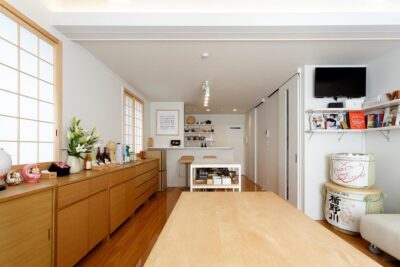
Ramen & Gyoza Cooking Class in Tokyo with Local Supermarket Visit
Read our review →
Sushi Making Osaka! Popular Sushi Class in Japan!
Read our review →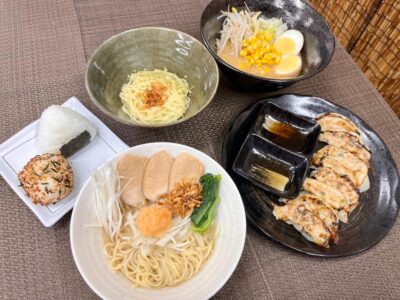
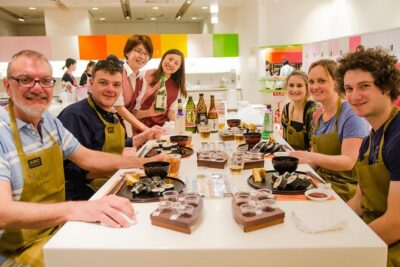
Tokyo Tsukiji Fish Market Tour and Sushi Making Lesson
Read our review →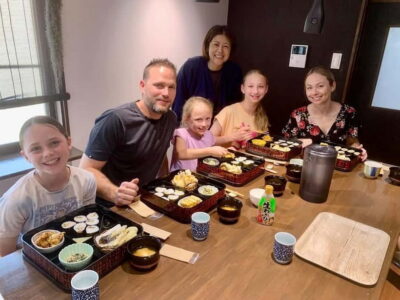
Kyoto: Japanese Washoku Bento Small Group Cooking Class
Read our review →
Osaka: Ramen and Gyoza Cooking Class in Dotonbori
Read our review →
Tokyo: Easy Ramen Cooking Experience in Kabukicho, Shinjuku
Read our review →This kitchen also appears in