Review · TBILISI
Tbilisi: Georgian Cooking Class with Khinkali and Khachapuri
The best part of this Tbilisi class is that you do not just eat Georgia’s famous comfort food. You fold the khinkali yourself, shape the dough, and learn why those little pleats matter. You also prepare Imeretian khachapuri, the round cheese-filled bread that is simpler and less showy than Adjarian khachapuri, but just as satisfying.
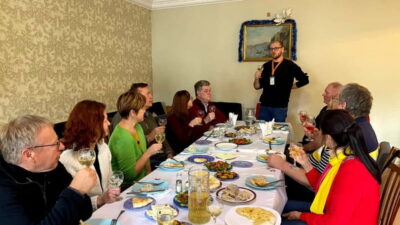
I like the hands-on format and the generous table of Georgian wine, local cheeses, fresh salad, and your finished dishes. I also like the friendly, social setup, which works well for solo visitors and small groups. The main thing to know is that the activity takes place in the restaurant, not in a working kitchen, so this is a relaxed food workshop rather than a professional culinary lesson.
Key points at a glance
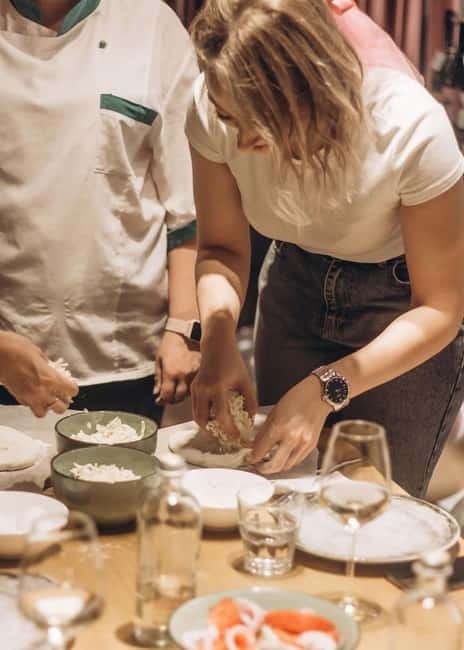
- Two Georgian classics: Prepare khinkali and Imeretian khachapuri from start to finish.
- A full meal included: Wine, local cheeses, salad, and your own cooking are part of the $28 price.
- Chefs who keep things easy: Instructors such as Artem, Nina, George, Seva, and Nino have led sessions with patient, step-by-step guidance.
- A sociable setting: Small groups, shared tables, and stories about Tbilisi make this a good meeting place.
- Recipes for later: You receive recipes or a recipe link so you can repeat the dishes at home.
- Central meeting point: St. Bunny is on the third floor of the Merani shopping center, between Rustaveli Avenue and Alexander Griboyedov Street.
Why khinkali and khachapuri make a smart first taste of Georgia
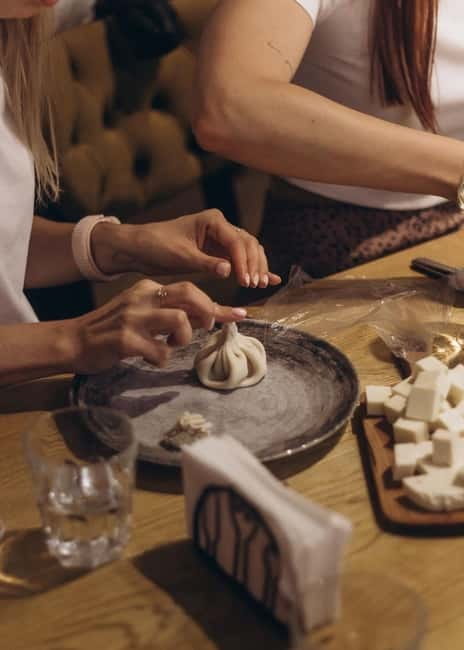
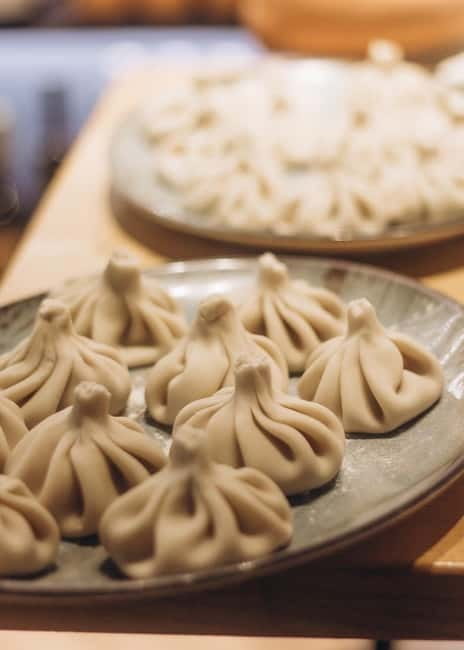
If you have time for only one food activity in Tbilisi, these two dishes give you a useful introduction to Georgian cooking. Khinkali are dough parcels filled with meat and broth. The trick is to gather the dough into a tight topknot, then eat the dumpling carefully so the hot juices do not run down your hand.
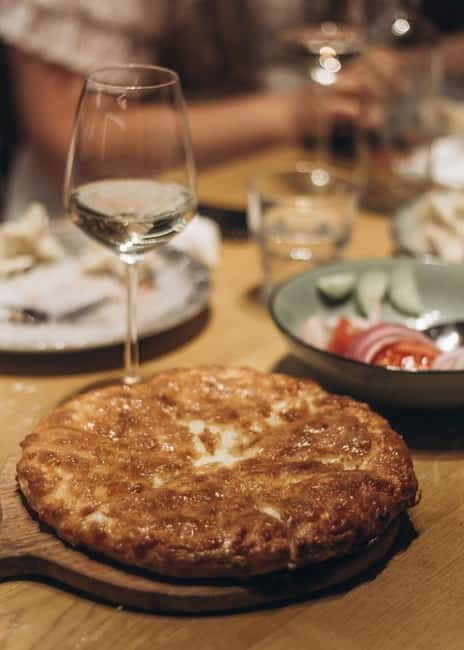
Khachapuri is Georgian cheese bread. The Imeretian version prepared here is round, filled with cheese, and folded into a soft bread shell. It is easier to handle than the boat-shaped Adjarian version, which is usually topped with egg and butter. That makes Imeretian khachapuri a sensible dish for a short class.
I like this pairing because the techniques are different. Khinkali teach you about filling, sealing, and handling dough. Khachapuri shows how Georgian cooks turn simple bread and cheese into something that feels festive. You leave with more than a meal. You understand why both dishes matter at Georgian tables.
More cooking classes around the world:
- Half-Day Thai Cooking Class at Organic Farm in Chiang Mai
★ 5.0 · 19,087 reviews - Florence: Pasta Cooking Class with Unlimited Wine
★ 4.9 · 10,285 reviews - 3 in 1 Cooking Class near Navona: Fettuccine, Ravioli & Tiramisu
★ 5.0 · 7,376 reviews
Arriving at St. Bunny in the Merani shopping center
The meeting point is St. Bunny restaurant, on the third floor of the Merani shopping center. You can enter from central Rustaveli Avenue or from Alexander Griboyedov Street, which runs parallel to the avenue.
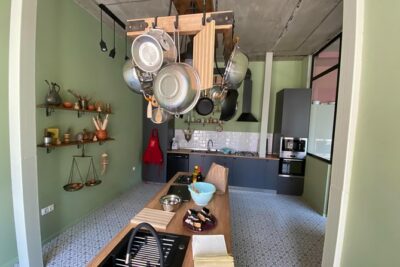
Give yourself a little time to find the restaurant inside the shopping center. The class is not held in the kitchen. Instead, you work in the restaurant setting, with the atmosphere of a distinctive Georgian courtyard and an attractive historic building. This matters if you are hoping to watch a professional kitchen at work. You will not get that here. The payoff is a more comfortable social space where you can sit, talk, and eat at the same table where you cook.
The location is useful for fitting the class into a day in central Tbilisi. It can work as an afternoon activity or as a relaxed food-focused start to the evening. The session lasts about two and a half hours, so avoid scheduling it too close to another fixed tour.
Wine, cheese, and a fresh Georgian welcome
The class begins with a glass of Georgian homemade wine, a plate of local cheeses, and a salad of tomatoes and cucumbers. The salad comes with aromatic Kakheti oil, linking the meal to eastern Georgia, one of the country’s best-known wine regions.
This opening is not just filler while you wait for the dough. It gives you a chance to settle in, meet the people at your table, and get a first taste of the ingredients used in Georgian homes. The cheese platter also helps you understand how much Georgian food depends on dairy, salt, herbs, and fresh produce.
There is plenty of food. The salad is generous, and you may have enough to take some home. Then come the khinkali and khachapuri, which make the whole meal filling. I would not plan a large dinner afterward.
The wine is included, but additional wine or food ordered from the menu costs extra. If you prefer a nonalcoholic start, the supplied information does not specify a replacement, so ask the organizer when booking.
Making khinkali, one pleat at a time
The khinkali lesson is the most entertaining part for many people. The chef explains the process, then guides you through the dough and filling. You work with the ingredients directly rather than watching a demonstration from across the room.
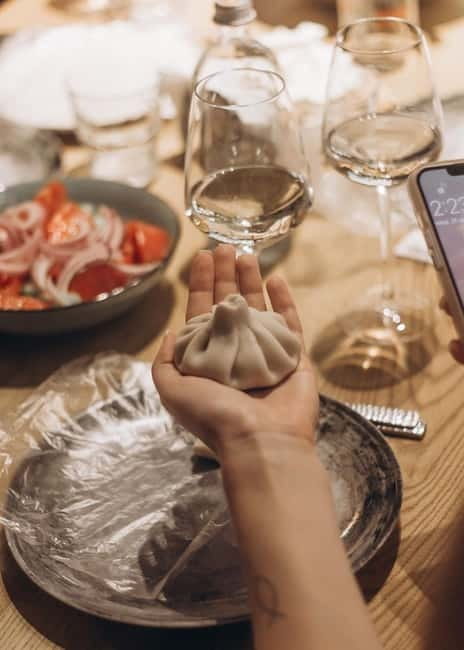
The folds can be tricky at first. The aim is not perfect restaurant-level uniformity. It is learning how to bring the dough together, seal in the filling, and create dumplings that hold their juices. The instructors are used to beginners and tend to correct small mistakes as you go. Past sessions led by chefs such as Artem and Seva have been described as patient, funny, and attentive, with clear help at each stage.
You might find that the class is more closely supervised than you expected. That is good news if you have never made dumplings, but less appealing if you want to experiment on your own. One practical criticism has been that the chef sometimes holds the process very closely, making the session feel partly like a dinner with instruction rather than a fully independent cooking workshop.
The important skill is eating the dumpling correctly. Pick up a khinkali by its topknot, take a small bite, and sip the broth before eating the rest. The class gives you a better sense of the dish than simply ordering a plate in a restaurant.
Same kitchen, a different dish:
- Florence: Pasta & Tiramisu Cooking Class with Unlimited Wine
★ 4.9 · 6,708 reviews - Florence: Pasta Cooking Class with Unlimited Wine
★ 5.0 · 6,413 reviews - Hanoi Cooking Class: Culture, Local Market & Meaning CSR Impact
★ 5.0 · 5,147 reviews - 5 Traditional Dishes Hanoi Cooking Class with Market Trip
★ 5.0 · 4,890 reviews
Filling and baking Imeretian khachapuri
The second dish is Imeretian khachapuri. You prepare the dough and filling with instruction from the chef, then watch the bread become a finished dish ready for the table.
This is a gentler task after the concentration required for khinkali. The shape is broad and round, and the cheese filling gives the bread its familiar soft, savory center. The chef explains the method in a way that suits first-time cooks, and the process is easy to follow even if you are not used to working with dough.
Be aware that the class makes Imeretian khachapuri, not necessarily the boat-shaped Adjarian style many visitors first picture. If your goal is to learn the egg-topped version, check the exact dish before booking. The Imeretian style is still a traditional Georgian favorite and is well suited to a group meal.
The food is cooked quickly enough that you do not spend long waiting around. That keeps the two-and-a-half-hour schedule lively, though it also means the class is not a slow, technical study of fermentation or baking science.
A meal that doubles as a social evening

After the cooking, you sit down and eat what you made. This is where the class feels more like a Georgian gathering than a standard cooking lesson. Wine, cheese, salad, khinkali, and khachapuri fill the table, and the chef or host shares stories about Tbilisi and Georgian food.
The group format is part of the value. Solo visitors can arrive without knowing anyone and still have an easy way to meet people. Couples and friends have room to work together, while larger groups can book the activity as a shared occasion. Group sizes vary, but several sessions have had only four people, while another group included ten colleagues.
The social side is not forced. You can focus on cooking, but there is usually time to talk after the food is ready. That makes this a useful activity early in a Tbilisi visit, when you may want informal tips and conversation. It also works well near the end of a trip, when a shared meal feels like a fitting final evening.
Some people find the portions too large. That is worth keeping in mind if you dislike food waste or have a small appetite. The salad can provide leftovers, and the meal is substantial enough that you should arrive hungry.
What the chefs do well
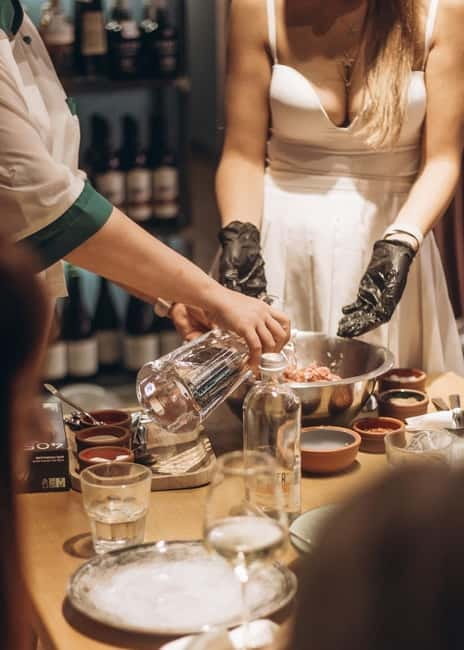
The strongest part of this experience is the teaching. The chefs explain the food, show the steps, watch your technique, and help before a small mistake becomes a failed dumpling.
Names vary by session. Artem, Artyom, Nina, George, Seva, and Nino have all been associated with especially friendly and clear instruction. You should not assume one particular chef will lead your date, but the pattern is consistent: the class is built around personal guidance rather than a speech followed by a hands-off demonstration.
The teaching also includes cultural context. You hear about the dishes and about Tbilisi, rather than simply being handed a bowl of dough. One instructor has been praised for tying the food to local history and daily life, while another helped a Georgian-born participant reconnect with childhood memories of making khinkali with family.
Instruction is available in English and Russian. If you are booking for a mixed group, confirm your preferred language in advance. The class is designed for beginners, and the clear demonstrations make it suitable for teens as well as adults.
Is $28 good value?
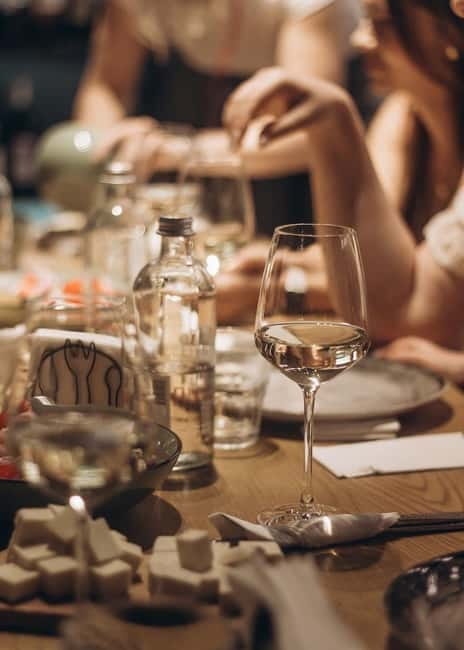
At $28 per person, this is strong value if you want both food and an activity. The price includes the cooking lesson, local cheeses, salad, Kakheti oil, homemade Georgian wine, and the meal you prepare. In Tbilisi, you could spend a fair amount on a dinner alone, but here you also get two and a half hours of instruction and a chance to meet people.
The value is best for someone who would otherwise book a food tour or sit through a restaurant meal without learning anything. You get a practical skill, a cultural story, and enough food to make the experience feel like dinner.
The price is less compelling if you are an experienced cook looking for advanced technique. You will not be studying professional kitchen systems, complex pastry work, or regional recipes beyond the two featured dishes. The class is friendly and accessible, not demanding.
There is also a useful practical benefit: recipes are provided at the end, sometimes through a link. That gives you a chance to recreate the dishes at home instead of leaving with only a pleasant memory.
Who should book this class?
I would recommend it to first-time visitors who want an easy introduction to Georgian food. It is also a good pick for solo visitors, couples, families with older children, and small groups of friends.
You will get the most from it if you:
- Like eating as much as cooking
- Want direct help rather than a formal demonstration
- Enjoy meeting people from different countries
- Have not made dumplings before
- Want a central Tbilisi activity lasting about two and a half hours
- Prefer a generous meal to a short tasting
I would hesitate if you want a professional kitchen setting, a quiet private lesson, or a highly technical course. The class can be private for some bookings, but the standard experience is social and group-oriented. You should also check the khachapuri style if Adjarian khachapuri is your main goal.
The venue is wheelchair accessible, and the activity has a separate entrance for the class. Cancellation is free up to 24 hours before the start time, and you can reserve now and pay later, which helps if your Tbilisi plans are still shifting.
My verdict on this Tbilisi food experience
I would book this class for an enjoyable, filling introduction to Georgia. The combination of hands-on dumpling making, fresh salad, cheese, wine, and a finished meal gives you more than a restaurant stop without making the afternoon feel like school.
The strongest reason to go is the chef’s close guidance. You are unlikely to be left wondering what to do with the dough, and the recipes give the experience a life beyond Tbilisi. Just arrive hungry, expect a restaurant rather than kitchen setting, and remember that Imeretian khachapuri is the style being prepared.
At $28, it is an easy recommendation for most people who want food, culture, and conversation in one compact activity. If you want advanced cooking instruction, choose something more technical. For a first taste of Georgian cooking, this is a very good fit.
FAQ
How long does the Georgian cooking class last?
The class lasts approximately two and a half hours.
What dishes will I prepare?
You will prepare khinkali and Imeretian khachapuri.
Is food included in the price?
Yes. The package includes local Georgian cheeses, a tomato and cucumber salad with Kakheti aromatic oil, Georgian homemade wine, and the khinkali and khachapuri you prepare.
Is wine included?
Yes, a tasting of Georgian homemade wine is included. Additional wine or food ordered from the menu costs extra.
Where does the class meet?
The class meets at St. Bunny restaurant on the third floor of the Merani shopping center. You can enter from Rustaveli Avenue or Alexander Griboyedov Street.
Is the class taught in English?
Yes. Instruction is available in English and Russian.
Will the class take place in a kitchen?
No. The event is held in the restaurant rather than in the kitchen.
Can I cancel the booking?
You can cancel up to 24 hours in advance for a full refund.
Is the activity wheelchair accessible?
Yes, the activity is wheelchair accessible.
New cooking classes around the world
- Shinjuku Tokyo: Authentic Japanese Home-Style Culinary Class★ 4.9 · 125 reviews
- Shibuya Tokyo: Onigiri & Tamagoyaki Cooking Class★ 5.0 · 4 reviews
- M.O.M COOKING CLASS★ 4.8 · 6 reviews
- Seville: Paella-Cooking Experience with Sangria & Full Meal★ 4.9 · 42 reviews
- Shanghai: Authentic Chinese Cooking Class with Master Chef★ 5.0 · 2 reviews
- Sestri Levante: Pesto & Cooking Classes, Wine Tasting★ 4.9 · 56 reviews
- Seville: Paella Cooking Class & 30-Min Local Expert Q&A★ 4.8 · 37 reviews
- Seoul: Korean Kimchi Cooking Class in the Heart of the City★ 5.0 · 3 reviews
Tbilisi Cooking Classes, side by side.

Small-Group Khinkali and Khachapuri Cooking Class in Tbilisi
Read our review →